
 English
 русский
 Español


Home / Author / Ayesha Rahman — Product After-Sales Service Manager / High-Performance Airport Air Baggage Labels for Reliable Global Sorting
News

High-Performance Airport Air Baggage Labels for Reliable Global Sorting
2026-09-21
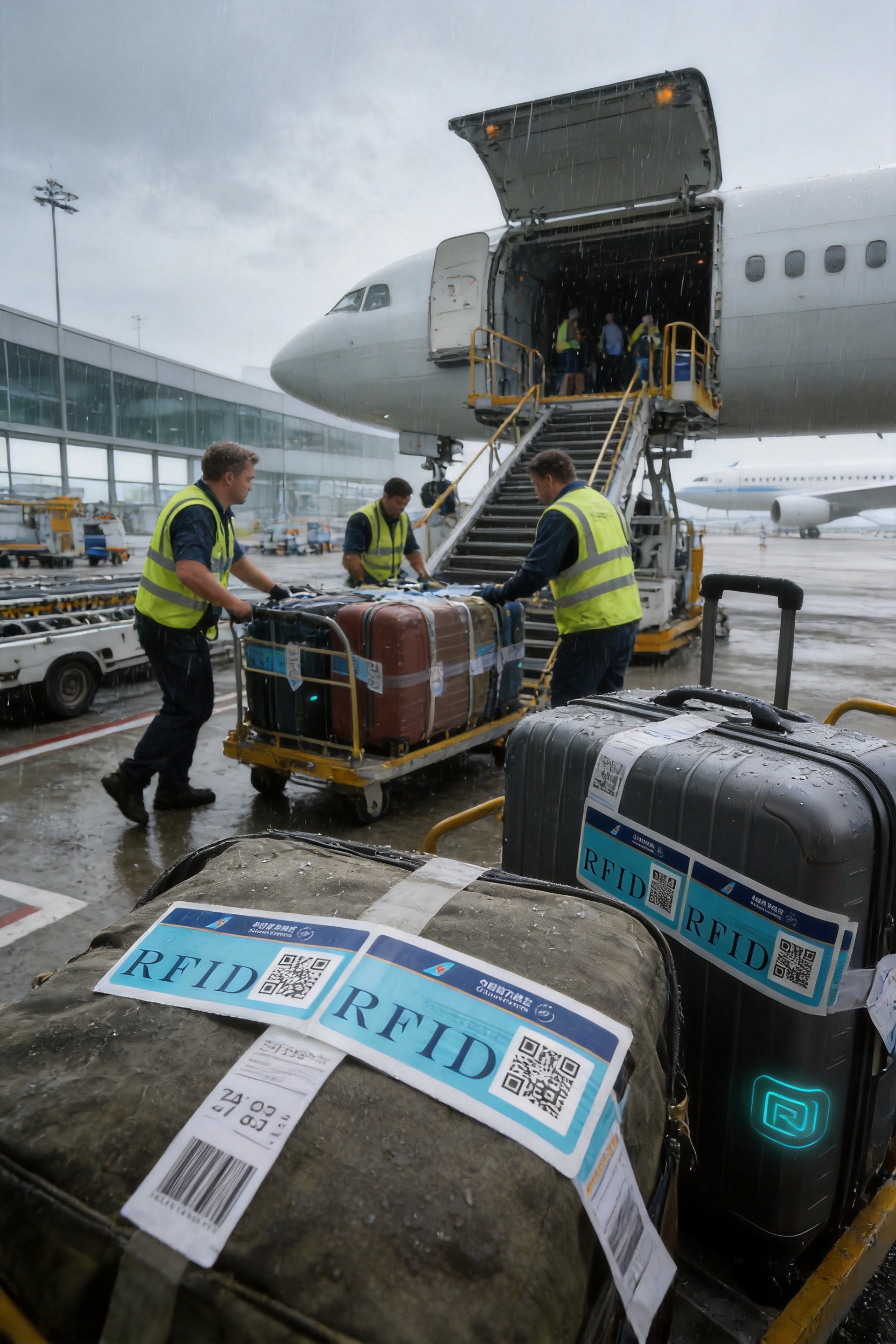
Air baggage moves through one of the most demanding logistics environments in the world. A single item of luggage may pass through check-in counters, security inspection points, transfer stations, baggage conveyors, loading areas, aircraft holds, arrival halls, and multiple airport sorting systems. During this journey, the baggage label must remain attached, readable, and accurately associated with the passenger and flight information. If the label becomes detached, torn, wet, or unreadable, the result may be delayed baggage, incorrect routing, manual intervention, or disruption to the passenger experience.
Airport air baggage labels are designed to solve these challenges. Developed for high-speed airport sorting and transshipment operations, they combine strong synthetic materials, heat-sensitive printability, durable information retention, and high-performance adhesion. Their purpose is not merely to identify a suitcase. They act as a critical information carrier within a multi-stage transportation network, supporting the accurate and efficient movement of baggage from origin to destination.
Shanghai Rongyang Industrial Development Co., Ltd. supplies customized pressure-sensitive labels and RFID smart label solutions for logistics, transportation, retail, food and beverage, pharmaceuticals, manufacturing, and other industries. Through integrated research and development, manufacturing, sales, and service capabilities, the company provides label products designed around the practical requirements of demanding operational environments.
Why Airport Baggage Identification Requires Specialized Labels
Airport baggage handling is a continuous, time-sensitive process. Large volumes of luggage must be identified and routed within narrow time windows. Unlike ordinary product labels, baggage labels are exposed to rapid mechanical handling, friction against conveyor equipment, rough luggage surfaces, humidity, water, pressure, bending, and repeated movement between different transportation stages.
The operating environment also creates information challenges. A baggage label may need to display or encode a barcode, flight number, destination airport, passenger information, transfer details, and other handling data. This information must remain clear enough for scanners and personnel to read at every relevant checkpoint. A small defect in printing or a partial loss of the label can compromise the entire routing process.
Airport luggage also varies considerably in surface texture and construction. Smooth hard-shell suitcases, woven fabric bags, soft travel cases, protective covers, and irregular luggage handles all present different adhesion conditions. A label that performs well on a clean, smooth surface may not perform adequately on a rough or flexible baggage exterior.
For these reasons, baggage labels must be engineered as logistics components rather than treated as ordinary stickers. The material, adhesive, printing surface, die-cutting format, and packaging method all contribute to operational reliability.
Product Overview
Airport air baggage labels are high-strength, heat-sensitive synthetic labels developed for baggage sorting, handling, and transportation. They are suitable for printing essential baggage information, including barcodes, flight numbers, destinations, and passenger details. The labels are manufactured to remain functional in high-speed, high-humidity, and mechanically demanding airport environments.
The label construction combines a durable synthetic face material with a high-adhesion backing. The synthetic material provides resistance to tearing, tensile stress, moisture, and water exposure. The heat-sensitive surface supports efficient thermal printing, allowing baggage information to be printed quickly at check-in or other baggage processing points.
The adhesive is designed to bond firmly to rough and irregular luggage surfaces. Once applied, the label helps maintain its position during conveyor movement, transfer handling, loading, unloading, and sorting. Its ability to remain attached and legible supports the accuracy of baggage identification throughout the transportation chain.
Product performance can be adapted to customer requirements through customized dimensions, formats, die-cutting, roll configurations, printing specifications, and packaging arrangements. This flexibility allows the labels to fit different airport systems and operational workflows.
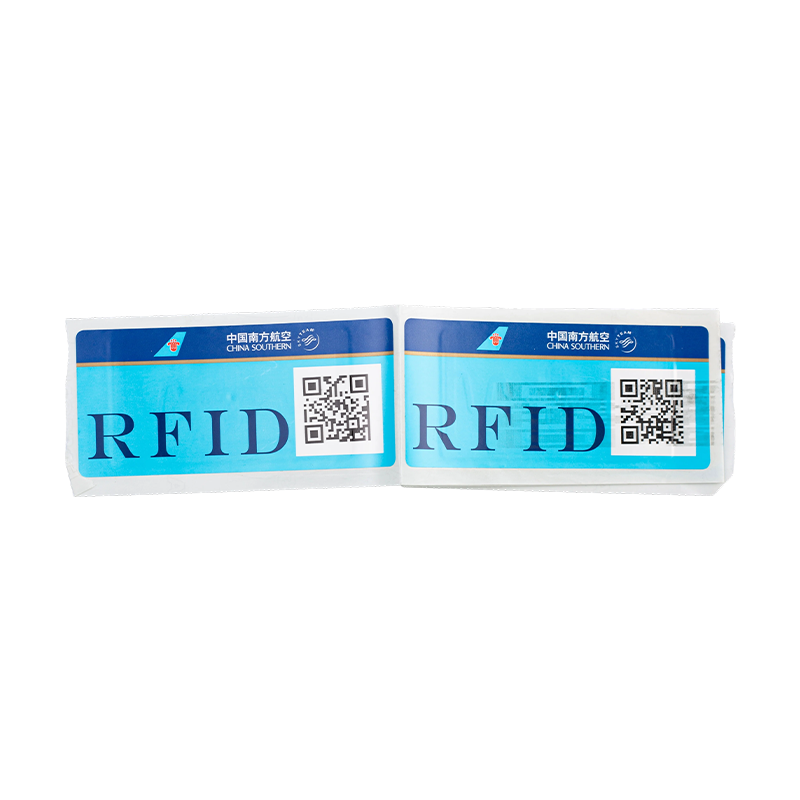
Airport air baggage labels
Core Advantages of Airport Air Baggage Labels
High Tensile Strength
During airport handling, baggage labels may be pulled, stretched, rubbed, or caught briefly against equipment. High tensile strength helps the label resist deformation and damage when exposed to these forces. The synthetic face material is constructed to remain stable during normal baggage movement and handling.
High tensile strength is especially valuable when the label is attached to flexible luggage or an area that bends during lifting. A weak paper-based label may crease or split under repeated stress. A stronger synthetic label can retain its structure and continue displaying the required information.
Excellent Tear Resistance
Tearing is one of the most common causes of label failure in logistics operations. Baggage may come into contact with conveyor belts, sorting chutes, baggage carts, loading equipment, and other luggage. A tear can remove part of a barcode or separate key information from the label.
Airport air baggage labels use high-strength synthetic materials with excellent tear resistance. This helps preserve the complete label structure when the luggage is handled repeatedly. Maintaining the integrity of the label reduces the risk that essential information will be lost during transportation.
Moisture and Water Resistance
Airport logistics systems may operate in rainy weather, humid climates, chilled areas, loading zones, and locations where condensation or water exposure is possible. Baggage can also be exposed to wet ground surfaces or damp handling conditions during transfer between terminals and aircraft.
The labels are designed with effective moisture and water resistance. This helps protect the label substrate and supports continued information retention in humid or wet environments. The material performance is particularly important for international routes that pass through different climates and weather conditions.
Heat-Sensitive Printing Performance
Thermal printing is widely used where information must be produced rapidly and efficiently. Airport baggage processing requires fast identification and minimal delay at check-in and transfer counters. A heat-sensitive label surface supports direct thermal printing without requiring a separate ink ribbon in the printing process.
The labels can accommodate key information such as barcodes, flight numbers, destinations, passenger details, and other routing data. The printing surface is designed to support clear information display, enabling scanning and visual verification during baggage processing.
Thermal printing also supports variable data. Each passenger and each item of baggage can receive information generated directly from the airport or airline system. This allows the label to be integrated into an electronic baggage management workflow.
Strong Adhesion to Rough Luggage Surfaces
Baggage surfaces are often textured, woven, curved, dusty, or uneven. A label must establish an effective bond even when the application surface is not perfectly smooth. The strong adhesive backing of these labels is designed for firm attachment to common luggage materials and shapes.
Reliable adhesion reduces the risk of labels lifting at the corners, peeling from curved surfaces, or detaching during handling. It also helps keep the printed information in the correct position for scanning and inspection. A stable label is particularly important when bags pass through high-speed sorting equipment.
Information Retention Throughout Transportation
The main value of a baggage label is the information it carries. A label that remains attached but becomes unreadable cannot effectively support baggage handling. The combination of a durable synthetic substrate, heat-sensitive printing surface, and resistance to moisture helps maintain the display of essential information.
Clear information retention supports several operational functions. Automated systems can scan barcodes, employees can verify destinations, transfer teams can identify flight details, and passengers can recognize their luggage at arrival. These functions depend on both physical durability and printing clarity.
Comparison with Conventional Baggage Label Materials
Conventional paper labels may be adequate for short-term indoor applications, but airport baggage handling places greater demands on label construction. Paper can be vulnerable to tearing, moisture absorption, surface abrasion, and deformation. When exposed to water or high humidity, the printed surface may lose clarity and the material may weaken.
High-strength synthetic baggage labels are developed specifically to address these weaknesses. They provide a more durable alternative for situations where luggage is exposed to repeated handling and changing environmental conditions.
| Performance Requirement | Conventional Paper Label | High-Strength Synthetic Baggage Label | Operational Benefit |
|---|---|---|---|
| Tensile stress | May deform or split under pulling and bending | Designed for higher mechanical strength | Improved structural integrity during handling |
| Tear resistance | More vulnerable to tearing at edges and folds | Strong resistance to tearing | Reduces loss of barcode and routing information |
| Moisture exposure | Can absorb water and weaken | Moisture- and water-resistant construction | Supports information retention in humid conditions |
| Surface compatibility | May struggle with rough or flexible luggage | High-adhesion backing for difficult surfaces | Helps maintain attachment during sorting |
| Thermal printing | May require application-specific paper grades | Heat-sensitive synthetic surface | Enables efficient variable-data printing |
| Transportation durability | Suitable mainly for lower-stress applications | Designed for airport sorting and transshipment | Supports consistent identification across multiple stages |
The practical advantage is not limited to material strength. A reliable baggage label can help reduce manual checks, relabeling, sorting errors, and interruptions caused by missing or unclear information. In a high-volume airport system, these improvements can contribute to smoother operations and better baggage flow.
Information Capacity and Printing Functions
Airport baggage labels must provide enough space for both machine-readable and human-readable information. Barcodes support automated identification and sorting, while printed text allows airport employees and passengers to verify key details. A well-designed label can present these elements in an organized format without compromising readability.
Typical information may include:
• Barcode or other machine-readable identification data.
• Flight number and scheduled route.
• Departure and destination airport information.
• Passenger name or passenger-related reference information.
• Transfer details for connecting flights.
• Handling instructions or internal routing information.
• Serial numbers or baggage reference information.
The label can be customized according to the requirements of the airport, airline, ground-handling company, or logistics service provider. Different organizations may use different barcode formats, label sizes, layouts, and printing systems. Custom production allows the label to match the available hardware and software workflow.
Thermal printing is particularly suitable for variable information because the data can be generated and printed immediately. This is valuable at passenger check-in counters, self-service bag-drop facilities, transfer desks, and other points where baggage information changes from one trip to another.
Adhesive Performance in Airport Operations
Adhesion is a critical part of baggage label performance. The label must remain attached to the luggage while allowing the baggage to move through multiple handling stages. A weak adhesive can lead to edge lifting, partial detachment, or complete loss of the label. These failures can occur at any point between check-in and arrival.
The high-adhesion backing is intended to bond firmly to rough luggage surfaces. It supports attachment to fabric cases, textured plastic, coated materials, and other common baggage exteriors. Because luggage surfaces vary, adhesive selection must balance initial tack, long-term holding strength, and compatibility with the intended application conditions.
Correct application remains important. The luggage surface should be reasonably clean and free from excessive dust, oil, or water at the moment of application. The label should be pressed firmly onto the selected area to promote contact between the adhesive and the surface. When the label is applied correctly, the adhesive helps it remain in place during high-speed sorting and transportation.
For customized projects, adhesive selection and label structure can be reviewed according to the customer’s baggage types, application process, storage conditions, and expected transportation duration. This approach helps ensure that the finished label is matched to its real operating environment.
Performance in High-Speed Sorting Systems
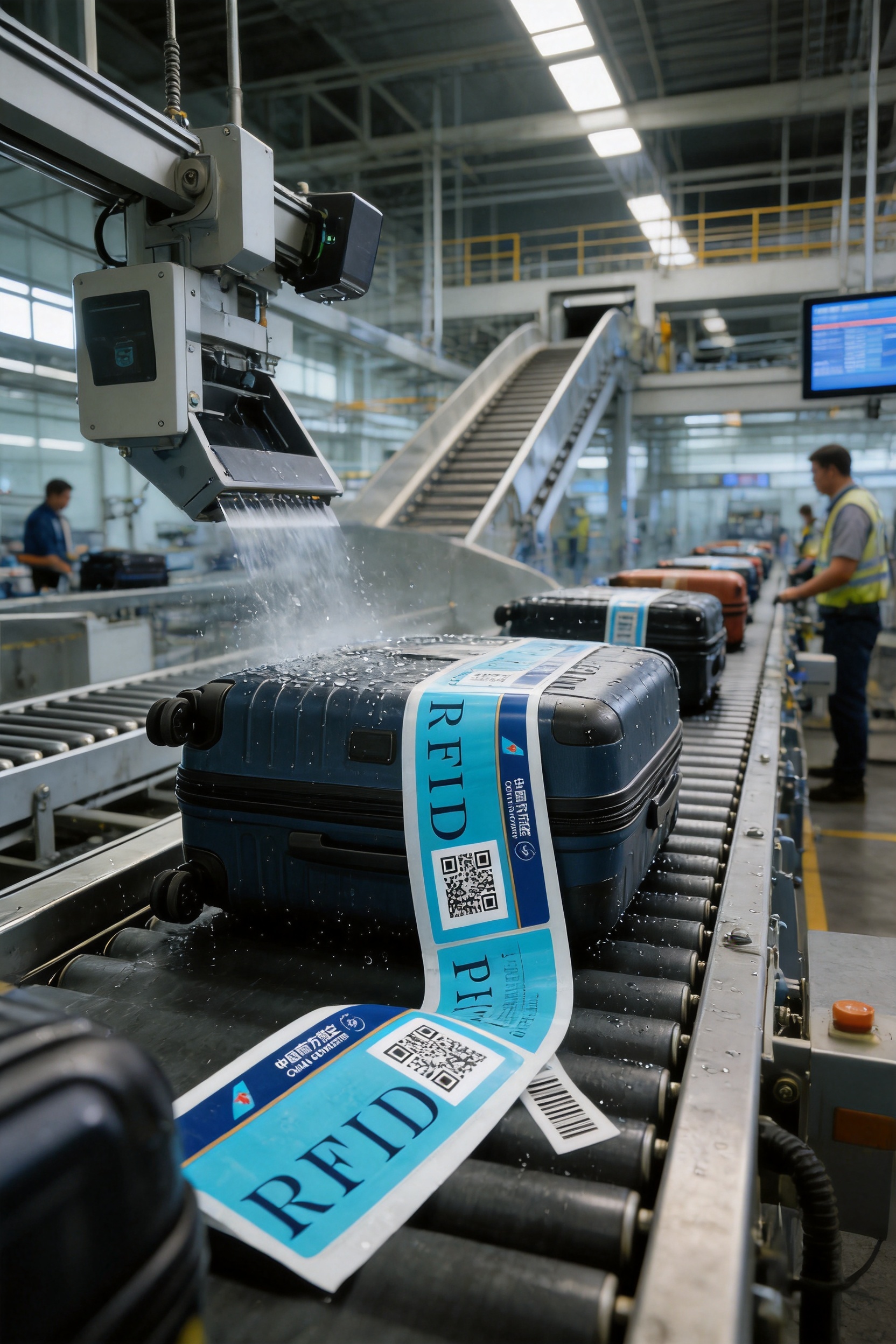
Modern airports use complex sorting systems to direct baggage to different flights and loading points. These systems may include conveyors, diverters, chutes, scanning stations, carts, and manual transfer areas. Luggage can move quickly and may be subjected to repeated impacts, friction, vibration, and changes in direction.
Airport air baggage labels are designed for this multi-stage process. Their high-strength construction helps resist mechanical damage, while their strong adhesive supports continuous attachment. Their thermal printing surface helps preserve the barcode and other information required for automated or manual identification.
Maintaining readable information through the sorting process helps reduce the need for manual identification. When a barcode can be scanned successfully, the system can direct the baggage according to the stored routing information. When text remains clear, employees can verify the destination and flight details during exceptions, transfers, or security checks.
The label therefore contributes to both automation and human decision-making. It supports the electronic connection between baggage and transportation records while also providing a visible physical reference on the luggage.
Application Across the Air Baggage Journey
Check-In and Bag Drop
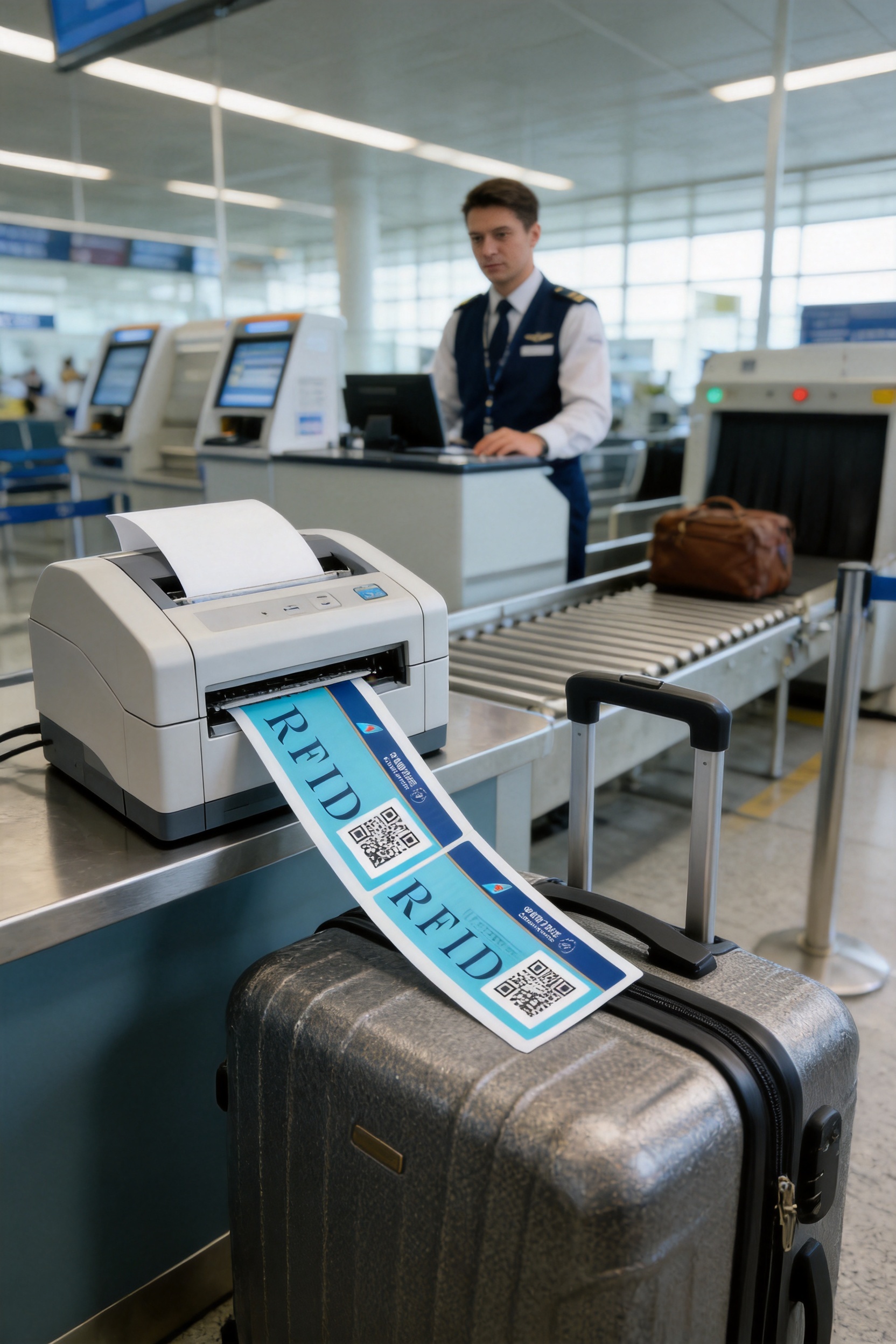
At check-in or bag drop, baggage information is generated and printed on the label. The label is then applied to the luggage before it enters the airport handling system. At this stage, fast printing, consistent label quality, and dependable adhesion are essential.
The label must be easy for staff or automated equipment to apply. Its format can be adapted to printing equipment and operational procedures. The printed barcode and flight information should be clear from the moment the bag enters the sorting process.
Security and Initial Sorting
After check-in, baggage may pass through security screening and preliminary sorting. It can be transferred between conveyors and inspection areas, where the label may encounter friction and mechanical movement. Strong material and adhesion help maintain the label’s position and condition.
Transfer and Transshipment
International and connecting flights often require baggage to pass through several transfer points. The label must continue to carry accurate information throughout these stages. High resistance to tearing and moisture helps support continued identification when the luggage is moved between systems or handled by different airport teams.
Aircraft Loading and Unloading
Baggage may be loaded into carts, containers, or aircraft compartments. This process may expose the label to compression, contact with other luggage, changes in weather, and physical handling. A durable label supports continued recognition during loading, unloading, and transfer between aircraft and terminal facilities.
Arrival and Passenger Collection
At the destination, the label helps direct baggage toward the correct reclaim area and allows the passenger to identify the luggage. The barcode and printed information remain useful during final sorting, exception handling, and manual inspection.
Customization Options for Different Airport Requirements
Airlines, airports, ground handlers, and baggage system operators may require different label configurations. Customization allows the product to align with local processes and equipment rather than forcing an existing format into an unsuitable workflow.
Possible customization areas include label length and width, roll or fan-fold configuration, core size, winding direction, die-cut shape, printed layout, information zones, adhesive type, and packaging quantity. The customer may also specify the thermal printer model, barcode format, application method, or environmental conditions.
Customization can be especially important for organizations operating across multiple airports or countries. A standardized label program can support consistent handling while still allowing local operational information to be included. The manufacturer can review the required dimensions, material performance, printing conditions, and delivery schedule before production.
In addition to standard pressure-sensitive labels, Rongyang provides specialized label solutions that may include RFID products, anti-counterfeiting functions, high-temperature resistance, removable adhesion, and special die-cutting. These capabilities support customers whose baggage, logistics, or asset identification systems require functions beyond ordinary printing.
Manufacturing Strength and Quality Control
Product performance depends on the quality of the manufacturing process. A label may appear simple, but its reliability is influenced by raw material selection, coating uniformity, adhesive application, slitting precision, die-cutting accuracy, printing compatibility, packaging, and inspection.
Shanghai Rongyang Industrial Development Co., Ltd. integrates research and development, manufacturing, sales, and service. This integrated structure enables the company to connect customer requirements with material engineering, production planning, quality management, and technical support.
The company operates advanced automated production lines and precision inspection equipment. Automation helps improve production consistency and repeatability, especially for large-volume orders. Precision equipment supports control over dimensions, cutting, material alignment, and finished-roll quality.
A stringent quality control system is applied from raw materials through finished products. This approach is important for airport labels because small variations in adhesive coating, material thickness, or die-cutting can affect application and performance. Quality management helps identify problems before products are released for shipment.
Rongyang’s product development capabilities cover pressure-sensitive labels and RFID smart labels. This broader technical background supports the creation of customized identification products for logistics and transportation applications. Customers can work with one supplier for conventional printed labels and smart label projects where both technologies are required.
Raw Material Control
Materials are selected according to the intended application. For airport baggage labels, the face material must support strength, tear resistance, moisture resistance, and thermal printing. The adhesive must provide strong attachment to the expected baggage surfaces. Controlled material selection is the starting point for consistent finished-product performance.
Automated Production
Automated production lines support stable processing and repeatable output. They can be used for coating, laminating, slitting, die-cutting, rewinding, and other production stages depending on the required product structure. Automation also helps support the production of large quantities within planned delivery schedules.
Precision Inspection
Inspection equipment helps verify the physical and functional properties of finished labels. Relevant checks may include dimensions, roll winding, die-cutting quality, surface appearance, print compatibility, adhesive condition, and packaging integrity. The exact inspection plan can be established according to product specifications and customer requirements.
Quality and Environmental Management
Rongyang has obtained ISO 9001 and ISO 14001 certifications and has passed the SMETA social responsibility audit. These certifications and audits reflect formal systems related to quality management, environmental management, and social responsibility. They provide an important foundation for customers seeking structured and accountable manufacturing partners.
Advantages of an Integrated Label Supplier
Working with an integrated label manufacturer can simplify the process from product design to delivery. Instead of coordinating separate suppliers for material development, printing compatibility, die-cutting, packaging, and technical service, customers can communicate with one production partner.
An integrated supplier can review the entire label structure and identify potential compatibility issues at an early stage. For example, the size of the label must match the printer and luggage application area. The adhesive must suit the surface. The printed information must fit the barcode layout. The roll configuration must support the customer’s dispensing equipment.
Rongyang combines product research, manufacturing, sales, and service. This structure supports communication across the project lifecycle. Customers can discuss application conditions, prototype requirements, material selection, production arrangements, inspection expectations, and delivery planning through a coordinated process.
The company has production facilities in China and Malaysia, supporting large-scale and international customer requirements. A multi-location manufacturing structure can help serve customers with international supply chains, regional delivery needs, or continuity requirements.
Support for Global and Multi-Stage Transportation Networks
Air transportation is inherently international. Baggage may cross national borders, pass through different airport systems, and be handled by multiple organizations. A baggage label must therefore retain its usefulness beyond a single local handling point.
The labels support this global operating model by carrying essential identification information in a clear and durable format. Their resistance to moisture, tearing, and mechanical stress helps them remain functional across different climates and handling environments. Their high-adhesion backing helps maintain attachment as baggage moves through separate transportation stages.
For airlines and airport service providers, consistent label performance can support standard operating procedures. For logistics partners, durable identification can help reduce uncertainty during transfer and exception management. For passengers, accurate baggage routing and recognizable information contribute to a more dependable travel experience.
How the Product Helps Reduce Operational Risk
No label can eliminate every baggage-handling risk, but a purpose-designed label can reduce risks related to physical label failure. When a label tears, detaches, or becomes unreadable, the luggage may require manual intervention. This can consume staff time and create delays, especially during peak travel periods.
Durable baggage labels help address several common risk factors:
• Loss of information caused by tearing.
• Reduced barcode readability caused by moisture or abrasion.
• Label detachment caused by weak adhesion.
• Misidentification caused by unclear printed details.
• Processing delays caused by the need for relabeling.
• Sorting interruptions caused by damaged identification.
By supporting stable identification, the label can contribute to more predictable baggage movement. The greatest value is achieved when the label is combined with correct printing, proper application, suitable handling procedures, and reliable airport information systems.
Procurement Considerations for Airport Operators
When selecting airport baggage labels, buyers should evaluate more than unit price. A low-cost label may create higher total operating costs if it results in frequent detachment, unreadable barcodes, manual sorting, or repeated replacement. Product selection should consider the full operating environment and the consequences of label failure.
Important evaluation factors include material strength, tear resistance, moisture resistance, thermal printing compatibility, adhesive performance, label dimensions, barcode readability, roll configuration, storage conditions, order quantity, and delivery capability.
The purchaser should also confirm whether the label can be customized for existing printers and application procedures. Compatibility with thermal printing equipment is particularly important because an unsuitable surface can create poor contrast, incomplete information, or unnecessary printer adjustments.
Testing in actual or simulated baggage-handling conditions is recommended before full-scale deployment. Tests may include bending, rubbing, exposure to humidity, water contact, adhesion to representative luggage surfaces, thermal printing, barcode scanning, and repeated handling.
Recommended Evaluation Process
Step One: Define the Application Environment
Identify the types of luggage, sorting equipment, climate conditions, handling stages, and expected transportation duration. Determine whether the labels will be used mainly indoors, outdoors, in humid regions, or across international routes.
Step Two: Confirm Information Requirements
Define the barcode type, text fields, logo or instruction areas, flight information, destination information, and any passenger-related data that must be displayed. Confirm the required label size and layout.
Step Three: Match the Printer and Roll Format
Specify the thermal printer model, label roll dimensions, core size, winding direction, gap or mark requirements, and dispensing process. This helps ensure smooth integration with current equipment.
Step Four: Test Adhesion and Durability
Apply sample labels to representative luggage materials, including fabric, textured plastic, coated surfaces, and curved areas. Test the labels under bending, rubbing, humidity, and water exposure conditions.
Step Five: Confirm Production and Quality Requirements
Review acceptable tolerances, inspection methods, packaging, batch identification, delivery schedules, and documentation. A clear specification helps maintain consistency throughout repeated orders.
Why Choose a Specialized Manufacturing Partner
A specialized label manufacturer understands that the product must fit both the material environment and the information workflow. The manufacturer’s role extends beyond producing adhesive-backed material. It includes recommending appropriate constructions, supporting printer compatibility, maintaining dimensional accuracy, controlling adhesive performance, and organizing dependable delivery.
Shanghai Rongyang Industrial Development Co., Ltd. has served the label industry since its founding in 2008. Its product portfolio covers pressure-sensitive labels for fast-moving consumer goods, food and beverage, pharmaceuticals, logistics, and retail, together with HF and UHF RFID inlays, tags, and finished products.
This broad application experience is relevant to airport baggage labels because the company works with many different requirements for identification, durability, adhesion, traceability, and automation. The company also provides customized solutions for anti-counterfeiting, high-temperature applications, removable adhesion, and specialized die-cutting.
Its facilities, automated production capabilities, inspection equipment, quality systems, and international production presence support customers seeking stable supply and technical cooperation. The company’s focus on continuous improvement and innovation further supports the development of labels for changing logistics requirements.
Environmental and Supply Considerations
Label manufacturers are increasingly expected to consider both product performance and manufacturing responsibility. ISO 14001 certification reflects a structured environmental management approach. While airport labels must be durable enough for demanding use, manufacturing processes should also be managed with attention to resource use, waste control, and environmental procedures.
Supply continuity is another consideration for international customers. Airport operations require regular availability of consumable labels. Delays in label supply can affect check-in and baggage-handling operations. Production facilities in China and Malaysia give Rongyang the capacity to support large-scale and international customer requirements.
Customers can discuss forecast volumes, safety stock, packaging specifications, delivery locations, and repeat-order schedules with the manufacturer. A planned supply program helps reduce the risk of unexpected shortages during seasonal travel peaks or operational expansion.
Practical Benefits for Different Stakeholders
For Airlines
Airlines benefit from consistent baggage identification, support for barcode-based workflows, and label performance across connecting flights and international routes. Durable labels can help reduce the number of bags requiring manual identification or relabeling.
For Airports
Airports benefit from labels that are compatible with automated sorting environments and able to withstand high volumes of movement. Clear information and reliable adhesion support efficient cooperation between check-in, security, sorting, transfer, and arrival teams.
For Ground-Handling Companies
Ground handlers work with baggage across many physical stages. Strong tear resistance, moisture resistance, and attachment performance help labels remain usable during loading, unloading, cart movement, and transfer operations.
For Passengers
Passengers benefit indirectly from accurate routing and better baggage identification. A label that remains intact and readable helps connect the luggage with its intended flight and destination, while also making the bag easier to recognize at baggage claim.
For Logistics and Technology Teams
Technology teams benefit from a label surface that supports variable thermal printing and barcode scanning. Where required, the broader product capabilities of an integrated label supplier can also support RFID and other smart identification projects.
Technical Strengths at a Glance
| Category | Product Capability | Application Value |
|---|---|---|
| Material | High-strength, heat-sensitive synthetic construction | Supports thermal printing and demanding baggage handling |
| Mechanical performance | High tensile strength and tear resistance | Helps maintain label integrity through sorting and transfer |
| Environmental resistance | Moisture and water resistance | Supports performance in humid and wet airport conditions |
| Adhesion | High-adhesion backing | Helps attach the label to rough and irregular luggage surfaces |
| Information display | Space for barcodes, flight, destination, and passenger information | Supports machine scanning and human verification |
| Customization | Customized sizes, structures, layouts, and formats | Allows integration with customer equipment and procedures |
| Manufacturing | Automated production and precision inspection | Supports consistency and large-volume supply |
| Company capability | Pressure-sensitive labels, RFID, special-function products | Provides options for broader identification programs |
Q&A: Airport Air Baggage Labels
What are airport air baggage labels used for?
They are used to identify, route, sort, and track baggage during airport check-in, security processing, transfer, loading, unloading, and arrival. They carry information such as barcodes, flight numbers, destinations, and passenger-related details.
Why are synthetic materials used for these labels?
Synthetic materials provide stronger resistance to tearing, tensile stress, moisture, and water than many conventional paper materials. This helps the label remain intact and legible during demanding airport handling conditions.
Can the labels be printed with thermal printers?
Yes. The labels use a heat-sensitive surface designed for thermal printing. They support the rapid printing of variable baggage information at check-in counters, transfer points, and other baggage-processing locations.
Will the labels adhere to fabric luggage?
The high-adhesion backing is designed to attach firmly to rough and irregular luggage surfaces, including common fabric and textured baggage materials. Actual performance depends on the cleanliness, condition, texture, and curvature of the application surface.
Can the label layout be customized?
Yes. Customers can discuss dimensions, printed information fields, barcode areas, die-cutting, roll configuration, winding direction, packaging, and other specifications according to their equipment and baggage-handling procedures.
How do these labels support automated sorting?
They provide a durable surface for printing barcodes and other machine-readable information. When the barcode remains clear and the label stays attached, automated sorting systems can more reliably identify and route the baggage.
Are the labels suitable for international transportation?
They are developed for multi-stage, cross-regional air baggage transportation. Their mechanical and environmental resistance helps support use across different handling stages, climates, and airport operating environments.
What should be tested before placing a large order?
Customers should test thermal printing, barcode scanning, adhesion to representative luggage surfaces, resistance to bending and rubbing, moisture performance, label dimensions, roll compatibility, and application procedures. Testing should reflect actual airport conditions as closely as possible.
What manufacturing capabilities does Rongyang provide?
Rongyang integrates research and development, manufacturing, sales, and service. It operates automated production lines and precision inspection equipment, maintains quality control from raw materials to finished products, and provides pressure-sensitive labels, RFID products, and specialized label solutions.
Does the company support large international orders?
Yes. With production facilities in China and Malaysia, the company is positioned to support large-scale and international customer requirements. Delivery planning and supply arrangements can be discussed according to order volume and destination.
Conclusion
Airport air baggage labels must perform reliably in a fast, complex, and highly interconnected transportation environment. They need to remain attached to luggage, resist tearing and moisture, support rapid thermal printing, and preserve essential information from check-in through final baggage collection.
High-strength heat-sensitive synthetic construction gives these labels a practical advantage over less durable alternatives. Their tensile strength, tear resistance, moisture and water resistance, strong adhesion, and information retention are directly aligned with the challenges of airport baggage sorting and transshipment.
Shanghai Rongyang Industrial Development Co., Ltd. strengthens this product offering through integrated research and development, automated manufacturing, precision inspection, structured quality management, international production capacity, and experience in pressure-sensitive and RFID label technologies. These capabilities enable the company to provide customized label solutions for airlines, airports, ground handlers, logistics providers, and other organizations that require dependable identification products.
For customers seeking a durable and adaptable baggage identification solution, airport air baggage labels provide an effective foundation for accurate sorting, efficient transportation, and reliable information continuity across the global air logistics network.
References
1. International Air Transport Association, general principles for baggage identification and handling operations.
2. ISO 9001, Quality Management Systems—Requirements.
3. ISO 14001, Environmental Management Systems—Requirements with Guidance for Use.
4. General technical practices for pressure-sensitive adhesive label manufacturing and inspection.
5. General operating principles for thermal printing, barcode identification, and automated baggage sorting.
6. Manufacturer-provided product specifications for high-strength synthetic airport air baggage labels.
7. Manufacturer-provided company information concerning pressure-sensitive labels, RFID products, production facilities, quality systems, and customized label solutions.
Product: Airport air baggage labels




Messae Us Right Now!

- Quick Links
- Products
- Quality Control
- Our Story
- News
- Contact
- Our Product
-
- Beauty and Personal Care Labels
- Home cleaning and laundry care labels
- Liquor and Beverage Labels
- Food and dairy product labels
- Healthcare Labels
- Promotional and Interactive Labels
- Specialty and industrial solution
- Labels Thermal printing and logistics labels
- Anti-counterfeiting traceability and RFID Labels
- Contact us
- Tel:+86-573-86867861
- Phone:+86-18621872035
- E-mail:allen.men@rylabel.com
- Add:No. 111 Xincheng Road, Haiyan Economic Development Zone, Jiaxing City, Zhejiang Province


