
 English
 русский
 Español


Home / Author / Lin Yuchan — International Sales Manager / General-Purpose Blank Die-Cut Thermal Labels for High-Throughput Logistics
News

General-Purpose Blank Die-Cut Thermal Labels for High-Throughput Logistics
2026-10-27

Logistics operations depend on the rapid exchange of accurate information. Every parcel, pallet, carton, shelf location, and warehouse order requires a clear identification method that can be produced quickly and applied with minimal effort. In this environment, general-purpose blank die-cut thermal labels provide a practical foundation for daily information management. They support shipping documentation, warehouse picking, inventory identification, transport coordination, and many other routine processes without requiring ink, toner, or complicated consumables.
The product discussed in this article is designed for logistics companies, e-commerce businesses, fulfillment centers, warehouses, distributors, and third-party logistics providers that require economical labels for high-volume printing. It combines cost-efficient thermal or thermal synthetic paper, precision die-cutting, broad compatibility with mainstream thermal printers, fast print performance, and reliable handling during application. These characteristics make it a versatile alternative to more expensive or less convenient labeling systems.
The Role of Thermal Labels in Modern Logistics
Modern logistics is built on speed, traceability, and consistent information flow. A package may pass through multiple warehouses, sorting centers, vehicles, and delivery stations before reaching its final destination. At each stage, employees and automated systems need to identify the package and understand its next destination. A printed label is often the most visible and immediately usable information carrier in this chain.
Thermal labels are especially suitable for logistics because they can be printed on demand. A warehouse operator can create a label when an order is received, when an item is picked, when a carton is packed, or when a shipment is transferred to a carrier. This reduces the need to store large quantities of preprinted forms and makes it easier to respond to changing order information.
Blank die-cut thermal labels are supplied without preprinted text or graphics, allowing the user to print variable information as needed. Depending on the application, this information may include barcodes, QR codes, order numbers, shipping addresses, routing details, inventory codes, dates, quantities, or handling instructions. The label format remains standardized while the content changes from one print cycle to the next.
This combination of a stable physical format and flexible digital content supports both manual and automated logistics processes. It is suitable for small businesses printing a few labels at a time and for large distribution operations processing thousands of parcels per hour.
Product Overview
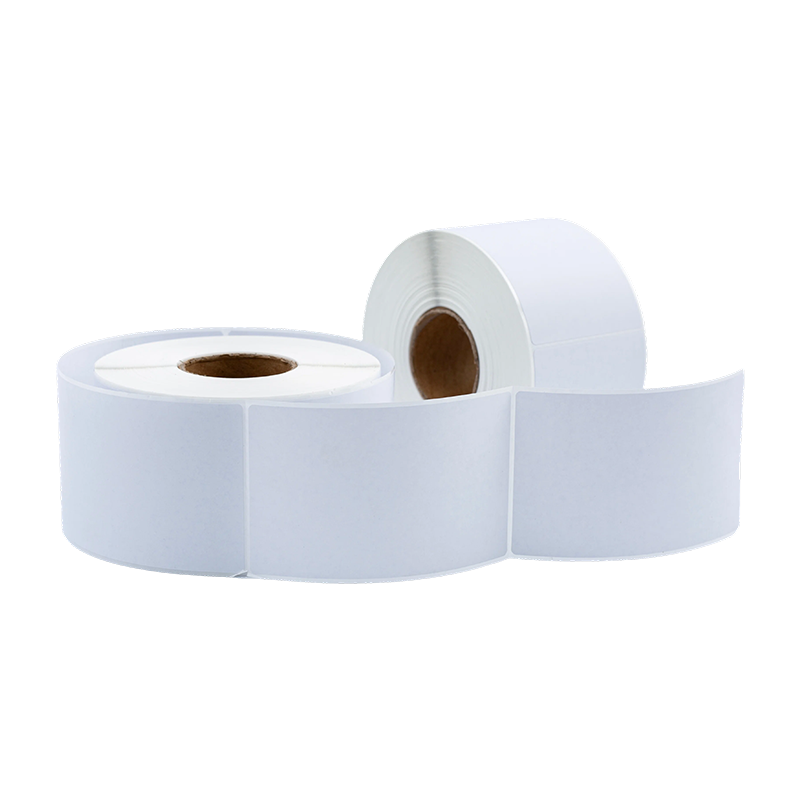
General-purpose blank die-cut thermal labels for logistics are manufactured from economical thermal paper or thermal synthetic paper. The material is converted into individual labels through precision die-cutting. Each label is separated by a clearly defined gap, allowing the printer and the operator to identify the beginning and end of each label accurately.
The labels are designed to work with mainstream thermal printers used for express waybills, warehouse labels, shipping labels, carton identification, and related applications. Their blank format provides a clean surface for direct thermal printing, while the die-cut structure supports smooth feeding and convenient application.
The product is positioned as a basic but highly important consumable. It does not attempt to replace every specialized label in the market. Instead, it focuses on the everyday logistics tasks where reliability, compatibility, speed, and low operating cost are more important than complex decorative finishes or advanced functional coatings.
For businesses managing large volumes of shipments, this focus is valuable. A label that performs consistently across routine applications can help reduce interruptions, simplify purchasing, and standardize warehouse procedures across multiple workstations or facilities.
Core Advantages of the Product
Cost-Efficient Material Selection
One of the primary advantages of the product is its use of cost-efficient thermal or thermal synthetic paper. Logistics labels are consumed in large quantities, so the cost of each individual label can have a significant effect on operating expenses. Selecting a material that provides dependable print performance while controlling unit cost helps companies manage their total labeling budget.
Thermal paper is widely used for short- and medium-term logistics applications because it does not require ink cartridges, ribbons, or toner. The thermal coating reacts to heat from the printhead and produces text, numbers, symbols, and barcodes directly on the label surface. This simplifies the printing system and reduces the number of consumable components that must be stocked.
Thermal synthetic paper can provide an alternative when greater resistance to moisture, abrasion, handling, or environmental exposure is needed. The appropriate material can be selected according to the application, transportation conditions, storage period, and expected level of contact with the label.
Compared with systems that require separate ink or ribbon management, direct thermal printing can make routine label production easier to operate. Users can concentrate on label design, printer settings, and workflow control instead of monitoring multiple consumables.
Precision Die-Cutting
Precision die-cutting is another important product strength. The label material is converted into consistently sized individual labels with controlled edges and stable spacing. Accurate die-cutting helps the label stock move through the printer in a predictable manner and supports clean separation during application.
Poorly cut labels can create several operational problems. Irregular edges may make labels difficult to peel, while inconsistent gaps can interfere with sensor recognition. Excessive adhesive exposure or incomplete cutting can cause labels to stick to equipment or separate unevenly. In a high-throughput environment, even a small percentage of defective sheets or rolls can lead to repeated delays.
By maintaining accurate label dimensions and separation, precision die-cutting contributes to smoother printer feeding and more efficient manual handling. The result is a consumable that is easier to use in standardized warehouse procedures.
Broad Thermal Printer Compatibility
The product is designed to match mainstream thermal printers used in logistics and warehousing. Compatibility is particularly important for businesses that operate mixed equipment fleets or have multiple facilities with different printer models. A broadly compatible label format reduces the risk that labels will work well on one machine but feed poorly on another.
Printer compatibility depends on several factors, including label width, label length, roll or fanfold format, gap spacing, core size, liner construction, and printer sensor settings. The product’s general-purpose positioning supports common logistics requirements, while users can select specifications that correspond to their equipment and application needs.
When a label is correctly matched to a printer, operators can benefit from fast printing speeds and fewer feed interruptions. This is especially important during shipping peaks, promotional campaigns, seasonal demand, and daily warehouse cut-off periods.
Fast Printing and Immediate Availability
Thermal printing allows information to be produced at the point of need. There is no drying period, and labels can usually be handled immediately after printing. This supports fast order fulfillment and reduces the time between label generation and package dispatch.
For a warehouse worker, the process can be straightforward: scan an order, confirm the relevant data, print a label, and apply it to the package or storage location. The limited number of process steps supports productivity and reduces the chance of confusion caused by preprinted labels that must be matched manually to specific shipments.
Fast printing is also valuable in cross-docking and distribution environments where goods may be received, sorted, relabeled, and dispatched within a short period. A dependable blank label supply enables operators to respond to changing routing or customer information without waiting for externally printed stock.
Clear and Durable Printed Information
The printed information on a logistics label must remain legible throughout the relevant handling cycle. Text and barcodes need to be readable by people and scanning equipment. The product is designed to provide durable print quality for common logistics applications, helping maintain the visibility of essential shipment and inventory information.
Durability requirements vary according to the use case. A label used for an indoor picking operation may need to remain readable for only a few days. A carton moving through a longer transportation chain may require stronger resistance to handling, rubbing, temperature variation, or occasional moisture. For these different needs, thermal paper and thermal synthetic paper can be selected according to the required service conditions.
Correct printer settings also influence print quality. Print density, speed, printhead condition, label surface, and storage conditions should be managed together. When the label material and printer are properly matched, users can achieve sharp characters and machine-readable barcodes without unnecessarily increasing energy use or printhead stress.
How the Product Compares with Common Alternatives
Different labeling technologies serve different purposes. General-purpose blank die-cut thermal labels are especially competitive when the application requires high-volume variable data, simple operation, and controlled cost.
| Evaluation Factor | Blank Die-Cut Thermal Labels | Inkjet or Laser Sheet Labels | Preprinted Fixed-Information Labels | Specialty Industrial Labels |
|---|---|---|---|---|
| Variable information | Excellent for on-demand printing | Suitable but requires ink or toner | Limited unless combined with another print process | Suitable, depending on material and printer |
| Consumable complexity | Low; no ink or toner required for direct thermal printing | Higher; ink, toner, or cartridges are required | Low during use but requires more inventory planning | Varies by construction |
| High-volume logistics use | Highly suitable | Less efficient for many small labels | Suitable only for repeated fixed data | Suitable where special resistance is essential |
| Print speed | Fast with compatible thermal printers | Varies by printer and document format | Fast application, but stock must be available | Varies by material and equipment |
| Operating cost | Generally economical | Includes ink, toner, and maintenance costs | May increase with design and inventory changes | Usually higher because of specialized materials |
| Best-fit applications | Waybills, picking labels, carton marks, and routine logistics | Office documents and occasional label printing | Repeated warnings, logos, or fixed product information | Extreme temperature, chemical, outdoor, or regulated environments |
Compared with inkjet or laser sheet labels, thermal labels generally offer a simpler print workflow for logistics applications. Users do not need to align individual labels on an office sheet, and they can avoid the recurring expense of ink or toner when using direct thermal printing. This can be especially beneficial where labels are produced continuously throughout the day.
Compared with preprinted fixed-information labels, blank thermal labels offer greater flexibility. A business can generate a unique label for every order or carton without maintaining separate stocks for different destinations, customers, product categories, or service levels.
Compared with specialty industrial labels, general-purpose thermal labels typically offer a lower cost and simpler construction. They are not intended to replace labels requiring extreme chemical resistance, long-term outdoor durability, high-temperature performance, tamper evidence, or specialized regulatory properties. However, for ordinary logistics workflows, using a highly specialized label can introduce unnecessary cost and complexity.
Applications Across the Logistics Workflow
Express Waybills
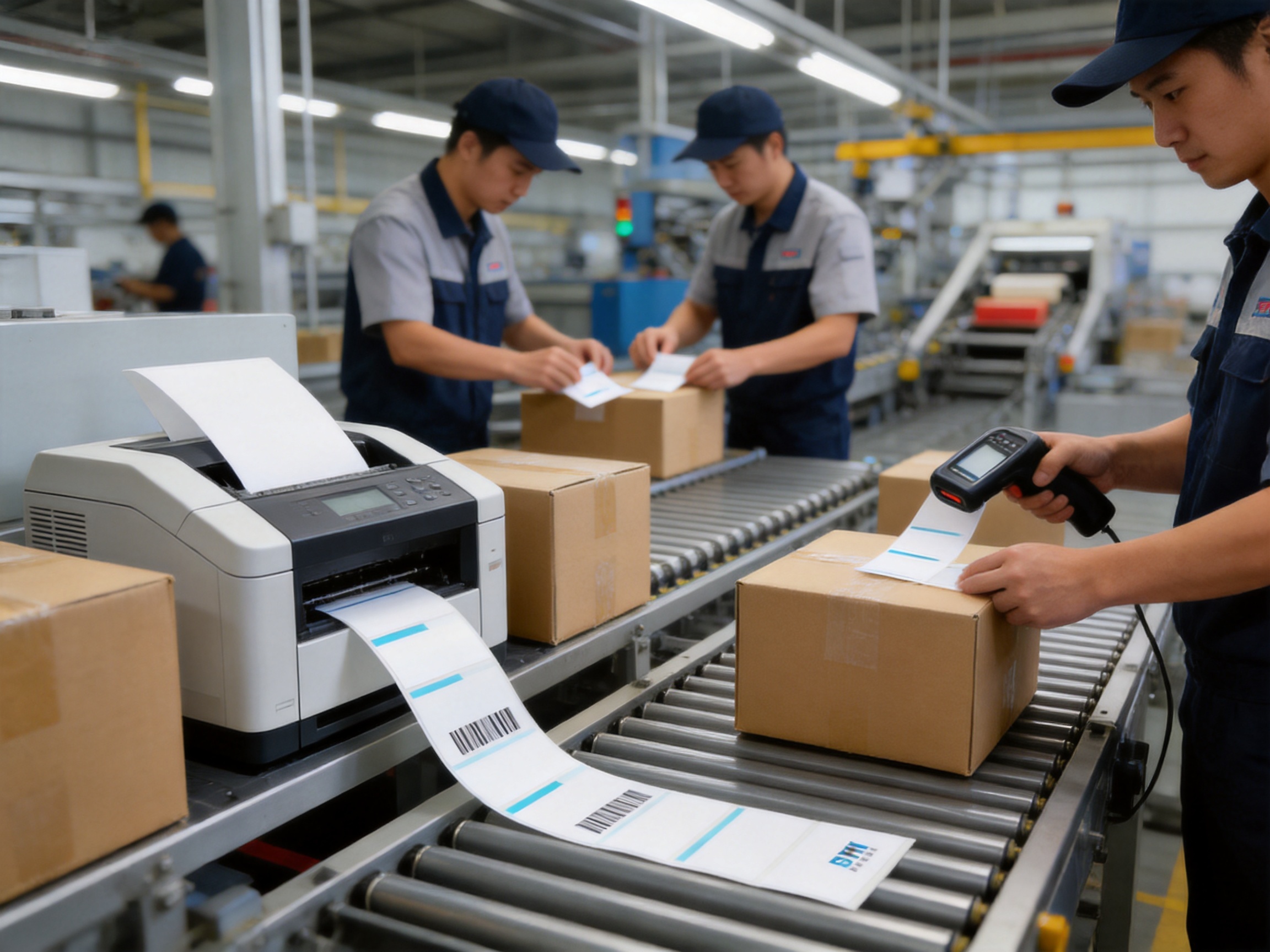
Express waybills are one of the most common applications for blank thermal labels. A waybill may include sender and recipient details, tracking numbers, barcodes, routing information, service type, weight, and handling instructions. Since each shipment contains different information, on-demand printing is more efficient than maintaining preprinted stock for every possible combination.
A well-produced thermal label supports quick scanning at sorting centers and delivery stations. Clear separation between labels helps operators remove the correct label efficiently, while consistent dimensions help reduce printer configuration changes.
For shipping counters, e-commerce fulfillment stations, and courier depots, the product can support a continuous flow of order processing. Its economical construction is well suited to routine parcel volumes where the label is expected to remain functional throughout transportation and delivery.
Warehouse Picking Labels
Warehouse picking labels identify products, bins, shelves, totes, and order groups. They may display item numbers, quantities, location codes, batch information, or instructions for the next stage of fulfillment. Because warehouse data changes frequently, blank thermal labels are a practical way to produce current information when required.
Picking labels can be printed at the start of a work order or generated dynamically as an operator moves through the warehouse. This flexibility supports barcode-based inventory control and can reduce the need for handwriting or manual transcription.
In high-throughput facilities, consistent label dimensions are important. Labels that feed smoothly and peel cleanly allow employees to maintain a steady pace. The die-cut format also helps create predictable placement on bins, cartons, shelves, and totes.
Shipping Box Markings
Shipping boxes often require additional identification beyond the carrier waybill. A carton may need a product code, internal order number, destination zone, consolidation reference, or handling message. Blank thermal labels allow this information to be printed in the warehouse using data from the order management or warehouse management system.
Because the labels can be produced immediately before dispatch, they help reduce errors associated with outdated stock. If a routing instruction changes or an order is split into several cartons, new labels can be generated without waiting for custom preprinted materials.
Inventory and Storage Identification
Inventory management depends on clear identification of stored goods. Thermal labels can be applied to cartons, cases, plastic containers, pallets, shelves, and temporary storage locations. Their compatibility with barcode printing makes them useful for receiving, put-away, cycle counting, replenishment, and stock transfer activities.
For short- and medium-term indoor storage, standard thermal paper may be sufficient. Where labels may encounter moisture, abrasion, or more demanding handling, thermal synthetic paper can provide an appropriate alternative. The material selection should reflect the expected storage conditions and the required reading period.
Third-Party Logistics Operations
Third-party logistics providers serve multiple customers, each with different labeling rules and data requirements. A general-purpose blank label platform gives these providers a common physical consumable that can support many customer workflows.
Instead of purchasing separate label constructions for every basic application, a 3PL operation can standardize common sizes and use software to change the printed content. This can simplify procurement, reduce storage requirements, and support consistent training across facilities.
Manufacturing Process and Quality Strengths
The quality of a thermal label depends not only on the raw material but also on the converting and inspection processes used during production. Shanghai Rongyang Industrial Development Co., Ltd. integrates research and development, manufacturing, sales, and service to provide pressure-sensitive label and RFID label solutions. This integrated structure supports coordination between product design, material selection, production, and customer requirements.
Material Preparation and Control
The manufacturing process begins with suitable labelstock selection. Thermal paper or thermal synthetic paper must provide a consistent printable surface and stable handling characteristics. The adhesive, face material, and release liner must work together so that labels remain attached during use while still being easy to dispense and apply.
Material control is important because variations in coating, thickness, adhesive distribution, or liner release can affect printing and converting performance. A controlled supply chain and incoming material inspection help reduce the likelihood of inconsistent rolls or sheets entering production.
For different logistics environments, the manufacturer can evaluate whether economical thermal paper or more durable thermal synthetic paper is appropriate. This approach allows the product to remain cost-effective while addressing practical differences between indoor warehouse use and more demanding transport conditions.
Precision Slitting and Die-Cutting
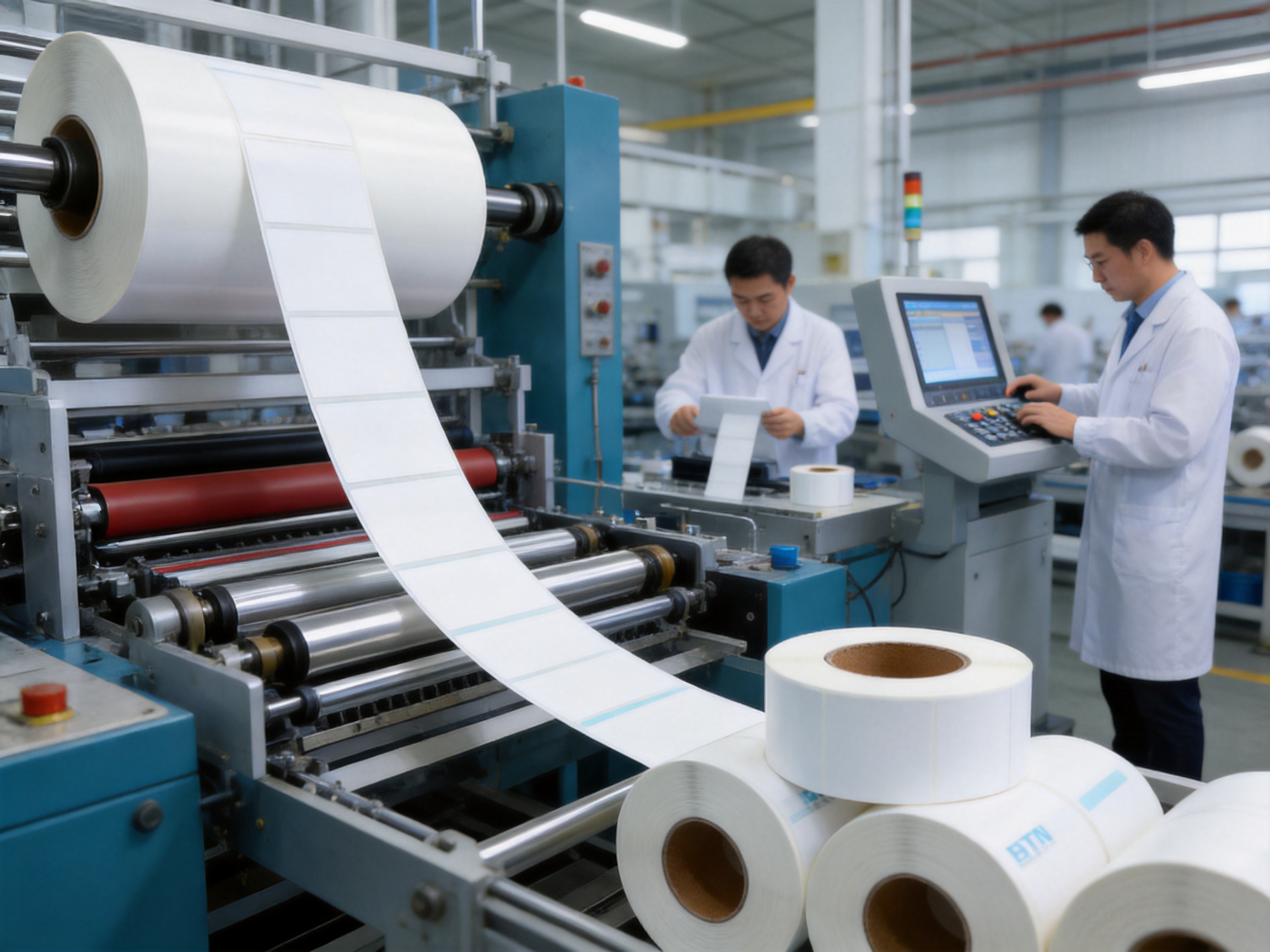
After material preparation, the labelstock is converted into the required format. Slitting controls the width of rolls, while die-cutting defines the shape and dimensions of each label. Accurate tooling and stable machine control are essential for maintaining consistent gaps, edges, and registration.
Precision die-cutting supports three important user benefits. First, it improves separation during dispensing. Second, it helps the printer recognize label gaps and advance the correct distance. Third, it contributes to a consistent appearance when labels are applied to packages, cartons, or storage equipment.
Production controls can include checks of label length, width, gap, edge quality, roll winding, core dimensions, and visual cleanliness. These controls are especially valuable for logistics users who rely on automated or semi-automated printing equipment.
Automated Production Lines
Rongyang operates advanced automated production lines and precision inspection equipment. Automation helps improve repeatability across long production runs and supports the manufacture of consistent label formats for high-volume customers.
Automated equipment can contribute to stable tension control, accurate material positioning, uniform die-cutting, and consistent winding. These factors influence how the finished label roll performs when installed in a thermal printer. A well-formed roll is less likely to telescope, loosen, or feed unevenly during use.
Automation also supports production efficiency. Higher process consistency can help the manufacturer serve customers with recurring label requirements while maintaining appropriate lead-time and quality objectives.
Inspection and Quality Assurance
Quality inspection is carried out from raw material stages through finished product preparation. Inspection may focus on dimensional accuracy, print surface condition, adhesive performance, die-cut integrity, roll appearance, and packaging protection.
A stringent quality control system helps prevent common defects such as missing labels, incomplete cuts, uneven gaps, excessive adhesive, surface contamination, or inconsistent winding. Preventing these defects before shipment is more efficient than requiring customers to identify and remove defective labels during a busy warehouse operation.
The company’s ISO 9001 certification reflects the use of a quality management framework. ISO 14001 certification also indicates attention to environmental management practices. In addition, the company has passed the SMETA social responsibility audit, supporting a broader approach to responsible manufacturing and business operations.
International Production Capability
With production facilities in China and Malaysia, the company is positioned to support domestic and international customer requirements. Multiple production locations can provide additional manufacturing flexibility for customers with regional supply needs, international distribution arrangements, or large recurring orders.
International customers often require more than a standard product specification. They may need packaging adjustments, different roll configurations, customized dimensions, inspection documentation, or coordination with regional printers and logistics systems. An integrated supplier with experience in export-oriented production can help address these requirements more efficiently.
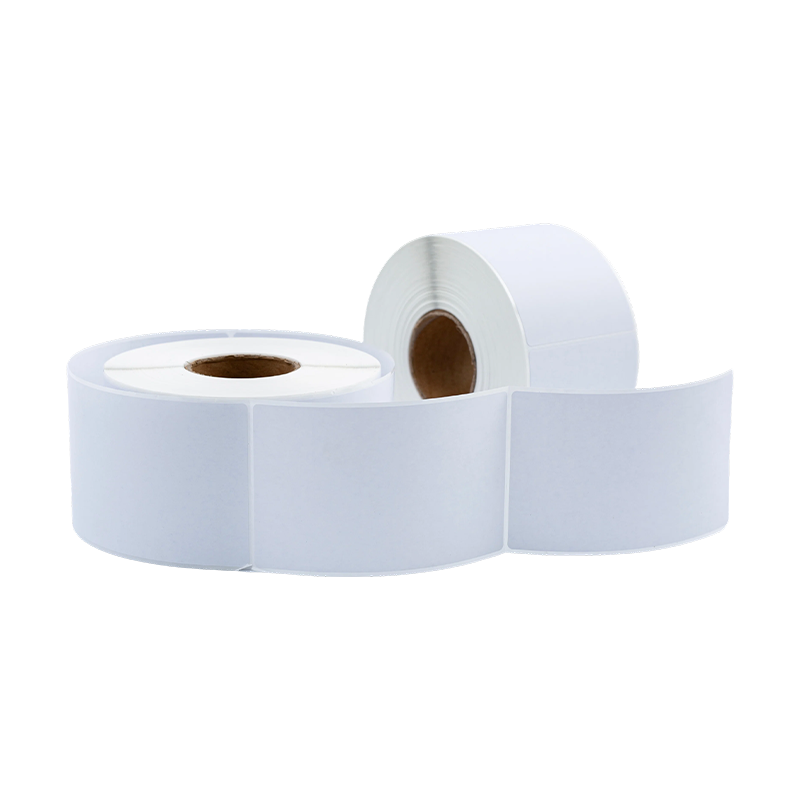
General-purpose blank die-cut thermal labels for logistics
Operational Benefits for E-Commerce and Warehousing
E-commerce fulfillment depends on the ability to process many orders with different products, destinations, and service levels. Blank die-cut thermal labels support this environment by allowing each package to receive accurate, order-specific information at the packing station.
For small and medium-sized online businesses, the product provides a straightforward way to professionalize shipping operations without investing in complex industrial printing systems. A compatible desktop or compact thermal printer can be paired with the labels to produce address labels, order references, and barcodes as orders are completed.
For larger fulfillment centers, the same product concept can support multiple workstations. Standardized label sizes make it easier to train operators, configure software templates, and maintain common purchasing specifications across facilities.
In warehouses, the product can also help separate internal and external information. For example, one label may display a carrier tracking number for shipment, while another identifies an internal picking batch or inventory location. Because each label is printed on demand, the information can be generated from the latest system records.
Reducing Labeling Errors
Labeling errors can lead to misrouted shipments, delayed deliveries, incorrect inventory records, and additional handling costs. Although a label cannot replace accurate software or operator training, a dependable printing consumable supports the overall error-control process.
Blank thermal labels reduce the risk of using outdated preprinted information. The operator can print the required data after the order has been confirmed. Barcodes and QR codes can be generated directly from the current transaction record, reducing the need for manual writing or copying.
Consistent label dimensions also help prevent layout problems. When labels maintain predictable width and length, software templates can be standardized. Operators are less likely to need frequent manual adjustments, and scanners can be positioned consistently.
Clear label separation supports accurate removal and application. If labels are difficult to separate, operators may accidentally apply two labels together or damage the printed surface. Precision die-cutting helps reduce this type of handling problem.
Storage, Handling, and Printer Setup
Proper storage is important for maintaining thermal label performance. Labels should generally be kept in a clean, dry environment away from excessive heat, direct sunlight, strong chemicals, and unnecessary pressure. Extreme conditions can affect the thermal coating, adhesive, liner, or roll shape.
Users should store labels in their original packaging until they are needed. Rolls should be protected from dust and moisture, and cartons should not be stacked in a way that deforms the label rolls. Stock rotation is also recommended so that older material is used before newer material.
Printer setup should correspond to the label format. The correct label width, length, gap, media type, and sensor mode should be selected. If the printer is configured incorrectly, it may advance too far, stop before the correct position, or print across label gaps.
Printhead cleanliness also affects output quality. Dust and adhesive residue can create blank lines, weak barcodes, or uneven density. Routine maintenance helps preserve both print quality and equipment life. Users should follow the printer manufacturer’s cleaning and maintenance instructions.
Print speed and darkness should be adjusted according to the label material and the required readability. Excessive darkness may consume more energy and increase printhead wear, while insufficient darkness can reduce barcode scanning performance. The optimal setting should be confirmed through practical testing.
Customization and Supply Options
Although the product is a general-purpose label solution, logistics requirements often vary by printer and workflow. Customization may include label width, label length, corner shape, roll diameter, core size, winding direction, gap spacing, adhesive selection, and packaging configuration.
Customers may also require different materials for different applications. Economical thermal paper can support standard indoor waybills and routine package markings. Thermal synthetic paper may be considered for shipments that face greater moisture, abrasion, or handling exposure.
Packaging can be organized according to the customer’s consumption pattern. Smaller packages may suit low-volume users or multiple workstations, while larger cartons can support high-volume facilities and reduce replenishment frequency. Clear outer packaging and specification labels can make inventory management easier.
As an OEM and private-label sticker printing factory, Rongyang can work with customers that require customized product identification, packaging, or label configurations. The company’s experience across pressure-sensitive labels, RFID products, and specialized label solutions supports a broad understanding of label construction and converting requirements.
Customized projects should begin with a clear technical specification. Important details include the printer model, media format, intended application, surface type, expected service period, temperature and moisture conditions, adhesive requirements, print content, order volume, and shipping destination. These details help determine the most suitable construction and production method.
Company Capabilities and Industry Experience
Shanghai Rongyang Industrial Development Co., Ltd. was founded in 2008 and has developed as an integrated provider of pressure-sensitive labels and RFID smart labels. Its product range serves FMCG, food and beverage, pharmaceuticals, logistics, retail, warehouse management, asset management, anti-theft systems, and smart manufacturing.
This broad industry experience is relevant to logistics label production because logistics environments rarely operate in isolation. A shipping label may need to work with retail packaging, pharmaceutical distribution, food supply chains, warehouse systems, or RFID-enabled processes. Experience across sectors can support more informed material and application recommendations.
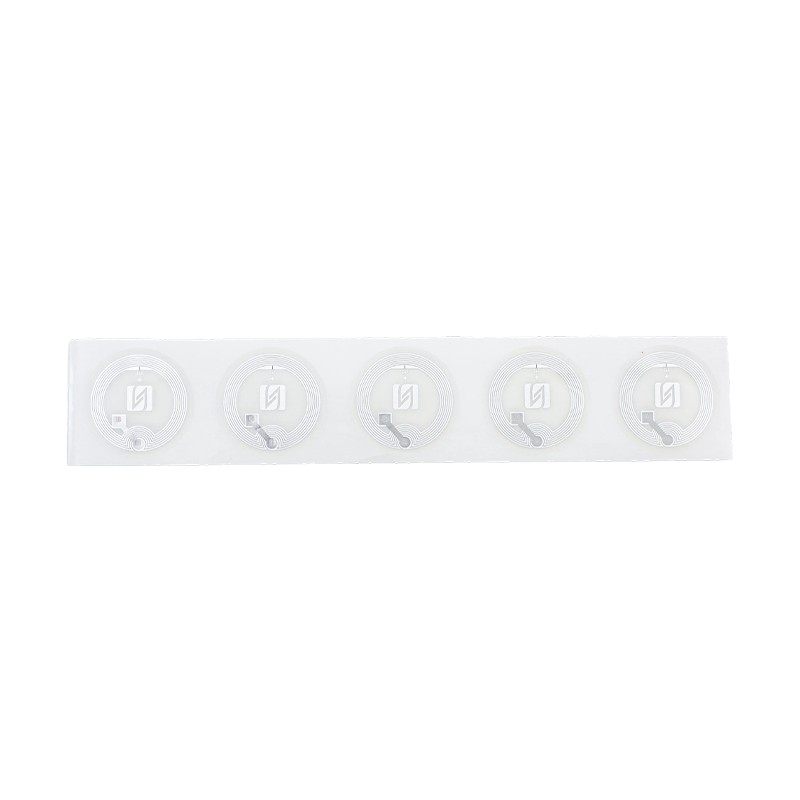
The company’s RFID capabilities include HF and UHF inlays, tags, and finished products. While RFID products serve different identification functions from standard thermal labels, both product categories depend on accurate converting, controlled materials, dependable quality, and an understanding of automated information systems.
Rongyang also provides specialized label solutions with functions such as anti-counterfeiting, high-temperature resistance, removable adhesion, and specialized die-cutting. These capabilities demonstrate that the company can support both everyday general-purpose labels and more demanding applications requiring special performance.
For customers purchasing routine logistics labels, this breadth can offer a practical advantage. A supplier that understands both basic and specialized label technologies may be able to help customers create a progressive labeling strategy, using economical thermal labels where appropriate and advanced solutions where operational conditions require them.
Environmental and Responsible Manufacturing Considerations
Label sustainability involves more than the face material alone. It includes material selection, production efficiency, packaging, transport, printer energy consumption, and the way labels are used. Direct thermal printing can reduce the need for ink cartridges and toner cartridges, which simplifies the consumable system and may reduce associated packaging and replacement activities.
Material selection should still be matched to the service period. Using a highly specialized material for a short-term indoor label may create unnecessary cost and material consumption. Conversely, using an unsuitable low-durability material may lead to relabeling, product handling, or disposal problems. The most responsible choice is generally the material that meets the application requirement without excessive specification.
ISO 14001 certification reflects the company’s environmental management framework. Environmental performance can involve resource management, waste reduction, process controls, compliance, and continual improvement. Customers seeking more responsible sourcing can include environmental requirements in their supplier evaluation and product specification process.
Efficient die-cutting and controlled production can also help reduce waste caused by defective labels, inaccurate dimensions, or poor roll formation. Stable production reduces the need to discard unusable stock and supports more predictable material utilization.
Recommended Selection Criteria
Before purchasing general-purpose blank die-cut thermal labels, users should review the complete application rather than evaluating price alone. The following criteria can help establish a suitable specification.
Printer Requirements
Confirm the printer brand and model, maximum media width, supported roll diameter, core size, sensor type, and preferred media format. If several printer models are used, test the label on each important model before approving a large order.
Label Dimensions
Select dimensions that provide enough space for the required text and barcode while fitting the package or container. Excessively large labels may increase material use, while labels that are too small can reduce readability and create layout problems.
Material Performance
Choose thermal paper for common short-term applications and consider thermal synthetic paper when improved resistance is needed. The decision should take into account temperature, moisture, abrasion, storage duration, and the expected handling cycle.
Adhesive Requirements
The adhesive should be appropriate for the surface to which the label will be applied. Corrugated cartons, plastic totes, metal containers, glass, and coated packaging can have different surface characteristics. Adhesion should be tested under actual storage and transport conditions.
Print Content
Review the amount of information to be printed, the required barcode type, font size, logos, symbols, and regulatory or carrier requirements. The label format should provide sufficient contrast and quiet zones for reliable scanning.
Order Volume and Packaging
Estimate average and peak consumption. Seasonal demand may be substantially higher than normal demand, so lead time and safety stock should be considered. Packaging should protect the labels during transportation and allow convenient storage at the point of use.
Implementation in a Logistics Operation
Successful implementation begins with process mapping. The business should identify where labels are created, who prints them, where they are applied, how they are scanned, and how long they must remain readable. This information helps determine whether one label format can serve multiple steps or whether separate formats are needed.
The next step is printer and software testing. A sample label should be printed using the intended order management, warehouse management, or shipping software. Users should verify text clarity, barcode readability, label positioning, printer feeding, and application speed.
Operators should receive simple instructions covering roll installation, printer calibration, label removal, storage, and basic troubleshooting. Standard procedures can help prevent common mistakes such as loading labels in the wrong direction, using an incorrect sensor mode, or storing rolls in a hot and humid location.
Performance should be reviewed after implementation. Useful indicators may include printer stoppages, label waste, scanning failures, reprint frequency, application time, and stock-out events. These measurements can help determine whether a different size, material, adhesive, or packaging configuration would improve the workflow.
Why a General-Purpose Solution Remains Valuable
Logistics companies often use advanced software, scanners, automated conveyors, and warehouse robots. However, the basic label remains an essential physical connection between digital information and the package or storage unit. A label must be printed, handled, applied, scanned, and recognized by people or machines.
The value of a general-purpose label lies in its ability to perform this basic role consistently at scale. It does not need unnecessary decoration or complex construction when the application calls for a clear barcode and reliable identification. Its strength is practical efficiency.
A standard thermal label can support many routine applications while keeping purchasing and inventory management straightforward. When combined with precision die-cutting, compatible materials, stable manufacturing, and quality control, it becomes a dependable operational tool rather than an insignificant consumable.
Frequently Asked Questions
What are general-purpose blank die-cut thermal labels?
They are pre-cut labels made from thermal paper or thermal synthetic paper without fixed printed information. Users print variable data such as barcodes, tracking numbers, addresses, order codes, and warehouse information directly onto the labels using a compatible thermal printer.
Do these labels require ink or toner?
Direct thermal printing generally does not require ink cartridges, toner, or ribbons. The printer uses heat to create the image on the thermal coating. Users should confirm whether their specific printer operates by direct thermal printing or thermal transfer printing before selecting the material.
What are the main applications?
Common applications include express waybills, warehouse picking labels, shipping box markings, inventory identification, carton labels, parcel routing labels, and temporary storage labels.
What is the benefit of precision die-cutting?
Precision die-cutting creates consistent label dimensions and clear separation points. This helps labels feed through the printer smoothly, improves dispensing, supports accurate application, and reduces the risk of paper jams caused by irregular edges or gaps.
Can the labels be used with different thermal printers?
They are designed to be compatible with mainstream thermal printers, but the exact specification must match the printer’s media width, length, core size, roll diameter, sensor system, and format. A sample test is recommended when several printer models are involved.
Should I choose thermal paper or thermal synthetic paper?
Thermal paper is suitable for many standard indoor and short- to medium-term logistics applications. Thermal synthetic paper may be more suitable when the label requires improved resistance to moisture, abrasion, or demanding handling conditions. The choice should be based on the actual service environment.
Are these labels suitable for e-commerce fulfillment?
Yes. They are suitable for printing order labels, carrier waybills, packing references, carton markings, picking labels, and other information required in e-commerce fulfillment operations.
How can print quality be maintained?
Use the correct printer settings, keep the printhead clean, store labels in a dry and moderate environment, and match the material to the printer. Print density and speed should be adjusted to achieve clear, scannable output without unnecessary printhead stress.
Can label dimensions and packaging be customized?
Customization may be available for dimensions, gap spacing, roll configuration, core size, winding direction, adhesive, material, and packaging. A detailed technical specification should be provided so that the product can be matched to the intended printer and application.
What makes this product different from highly specialized labels?
The product focuses on everyday logistics requirements: low cost, fast printing, broad compatibility, easy handling, and dependable information display. Highly specialized labels remain more appropriate for extreme temperatures, harsh chemicals, long-term outdoor exposure, tamper evidence, or other demanding conditions.
Why is supplier manufacturing capability important?
Manufacturing capability affects material consistency, die-cut accuracy, roll quality, inspection, order reliability, and customization support. A supplier with automated production lines, precision inspection equipment, quality certifications, and international facilities can provide stronger support for recurring and large-scale requirements.
Conclusion
General-purpose blank die-cut thermal labels provide a practical information carrier for the logistics industry. Their economical thermal or thermal synthetic paper construction, precision die-cutting, fast printing performance, broad printer compatibility, and easy handling make them suitable for high-volume daily operations.
They support express waybills, warehouse picking labels, shipping box markings, inventory identification, and third-party logistics workflows. Compared with more complex or expensive alternatives, they offer an efficient balance of cost, flexibility, and operational simplicity. Their blank format allows businesses to print accurate variable information at the point of need, while their standardized physical construction supports repeatable processes across workstations and facilities.
The strength of the solution also depends on manufacturing discipline. Advanced automated production lines, precision inspection equipment, controlled material selection, and a comprehensive quality management system help ensure that finished labels feed smoothly, separate cleanly, and deliver stable print performance. Shanghai Rongyang Industrial Development Co., Ltd. combines these manufacturing capabilities with experience in pressure-sensitive labels, RFID products, and specialized label solutions.
For e-commerce businesses, warehouses, distributors, and 3PL companies, the product offers a dependable foundation for information management. When the label specification is properly matched to the printer, application surface, environmental conditions, and required service period, it can help reduce downtime, control consumable costs, improve scanning consistency, and support the steady movement of goods through the supply chain.
References
International Organization for Standardization. ISO 9001 Quality Management Systems: Requirements.
International Organization for Standardization. ISO 14001 Environmental Management Systems: Requirements with Guidance for Use.
International Organization for Standardization. Guidance on Quality Management and Process Control in Manufacturing Operations.
Association for Automatic Identification and Mobility. General Principles of Barcode Print Quality and Symbol Readability.
International Air Transport Association. Cargo Labeling and Handling Marking Principles.
GS1 General Specifications. Identification, Data Capture, Barcode, and Supply Chain Labeling Practices.
Thermal Printing Industry Technical Guidance. Direct Thermal Media Selection, Storage, Printer Calibration, and Maintenance.
Product: General-purpose blank die-cut thermal labels for logistics




Messae Us Right Now!

- Quick Links
- Products
- Quality Control
- Our Story
- News
- Contact
- Our Product
-
- Beauty and Personal Care Labels
- Home cleaning and laundry care labels
- Liquor and Beverage Labels
- Food and dairy product labels
- Healthcare Labels
- Promotional and Interactive Labels
- Specialty and industrial solution
- Labels Thermal printing and logistics labels
- Anti-counterfeiting traceability and RFID Labels
- Contact us
- Tel:+86-573-86867861
- Phone:+86-18621872035
- E-mail:allen.men@rylabel.com
- Add:No. 111 Xincheng Road, Haiyan Economic Development Zone, Jiaxing City, Zhejiang Province


